This weekend myself and Bam (Best Aussie Mate) did our first 'chester' walk, through Ancaster in Lincolnshire. The weather was absolutely amazing, in fact, probably way too hot to be outdoors for seven and half hours! But we had a great walk - the first one I've ever designed all by myself and I would recommend it to anyone who is living in or visiting the area.
Grantham to Belton Park Gates (2 miles/3.2 kilometres)
We arrived in Grantham on Friday night, after work and stayed at a lovely B&B called The Red House on North Parade, run by a couple of (Thai?) ladies. We had dinner in the restaurant of The Angel and Royal, which was a really nice place to eat and gave myself and Bam a much needed opportunity to catch up on our respective lives, not having seen each other for about two months. Bam told me about her favourite new song, Bang Bang Bang by Mark Ronson and the Business Intl, so that became our them song for the trip!
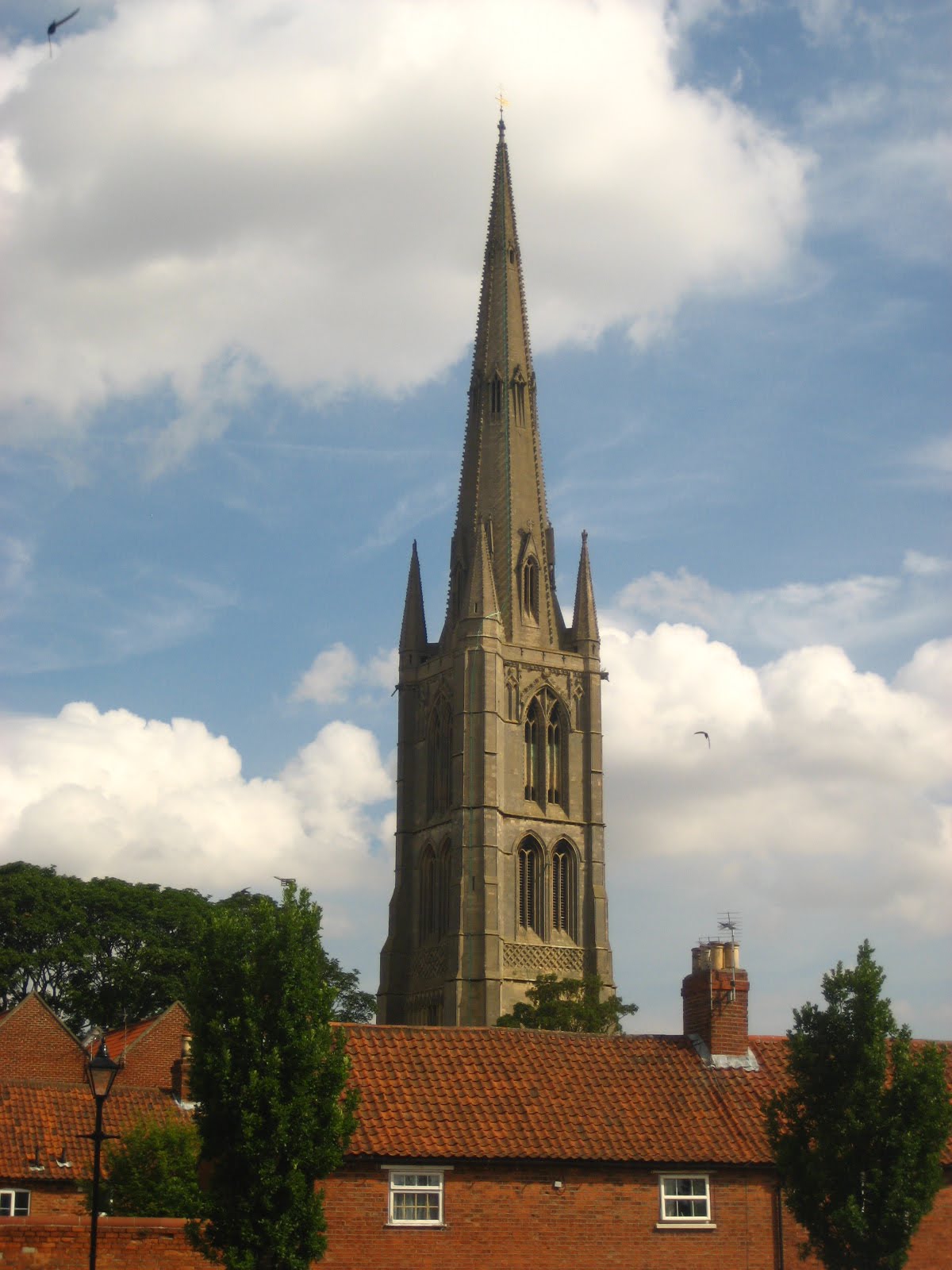
After a hearty breakfast, we set off to St Wulfram's Church at about ten the following morning. The volunteers at St Wulfram's are incredibly friendly and we had an interesting time exploring the crypt and the exhibition room. St Wulfram was a 7th-century Bishop of Sens, in France and is remembered for his missionary work in Friesland. There are only two churches dedicated to him in England, the other one being in Sussex. Grantham ended up with one of his arms, somehow, and St Wulfram's Church sheltered this relic for many years, although his arm seems to have been mislaid sometime during the Reformation. I guess St Wulfram was the 7th century version of a celeb! Perhaps this isn't such a modern phenomenon after all. The church also has the sixth highest spire in England, which is surprising, as Grantham isn't exactly famous for it's landmarks or religion.
Grantham is famous as the birthplace of Margaret Thatcher, who lived above her father's shop in the town. It was also the place that Isaac Newton first studied mathematics and lived above an apothecary. It's amazing that this, most unremarkable of English towns, should produce two such influential people. I'm going to blog more about Isaac Newton later and I'm interested in the influence that his upbringing had on his genius. Grantham was also the first town in Britain that had women police officers on the beat, Edith Smith and Mary Allen! I found this plaque on a bench on the High Street and it struck me as being quite ahead of its day, having a Business and Professional Women's Club in the 1950's. Perhaps not that remarkable after all for the town that produced Britain's first (and to date, only) female Prime Minister.
Our walk really began in the centre of Grantham, just outside the Guildhall Arts Centre (pictured), we started by walking down Avenue Road, across the Stone bridge and then left alongside the River Witham on a path which is part of the National Cycle Route 1. At Hill Avenue we turned right onto Belton Lane and followed this all the way down to the gates of Belton Park. It's a pleasant suburban walk, but the array of signposts related to the cycle network and circular town walks can be confusing.
Belton Park Gates to Belton House (1.5 miles/2.4 kilometres)
Belton Park is a really amazing place and I had planned my route through it, without expectations as to what the park might be like. Arriving at the park gates, with that sweeping view of the park and Belton House at the end of it, I was immediately transported back several centuries and could almost hear the carriages rattling up the 1.5 mile drive to the house, amidst the grazing sheep and sunburnt landscape. Belton House has a really lovely visitors centre, with giftshops, toilets, cafes and an exhibition of carriages. We didn't have time to go inside and visit the house, which is a National Trust property, but I bought a book about the house and its history which, hopefully, I will be able to share with you at a later date.
Belton House to Ancaster (5 miles/8 kilometres)
Belton village itself is an amazing little place. When you come to the fork in the village, just after the telephone box, take the road to the right, which skirts the grounds of Belmont House and takes you through Barkston Heath, via Syston Grange, along a relatively quiet country lane with surprisingly hilly bits and fantastic views over the Lincolnshire countryside. The only part of the walk that got 'hairy' was when we finally reached the B6403, a.k.a. the High Dyke or Ermine Street, the route of the Ancient Roman road from London to the Humber. I don't know if it's legal, but you could possibly walk along the outside of the airfield which is on Barkston Heath and has a road running parallel to the B6403 and is certainly a less treacherous option. My abiding memory of this part of the walk was Bam telling me about Alfred Hitchcock's The Birds and the novella it was based on by Daphne DuMaurier, which was more explicit in its references to the Cold War and fears of a Communist invasion.
To get off the B6403 we turned right down a country lane leading to the village of Wilsford, turning left about halfway down this lane to follow a bridleway along the top ridge of a small valley, eventually leading us to Ermine Street in Ancaster.
Ancaster to South Rauceby (4 miles/6.4 kilometres)
Ancaster was the main focus of our walk and we stopped off on Ermine Street to have a banana and a soft drink. I don't usually eat a lunch when I'm doing a full-day walk, but prefer to have a massive breakfast and then something substantial at dinner time. I do however spend most of the day eating nuts and dried fruit (or Trail mix, as Bam likes to call it) and, with the high temperatures this weekend, I also drank three litres of water during the walk, which just about kept me hydrated.
The church at Ancaster is called St Martin's and it'll be interesting to see how many other casters/chesters have churches dedicated to St Martin, who is the patron saint of soldiers and an apt choice for what used to be a Roman camp. It was also interesting to note the RAF presence around Ancaster and I find it intriguing to think that there has been a military presence in the area since Roman times! Channel Four's Time Team visited Ancaster back in 2002 and found evidence of a Romano-celtic shrine to a God named Viridio. This is thought to be an incorporation of Celtic animist beliefs, such as the Green Man and the Roman temple which stood on the site of today's church.
We left Ancaster on a trail recommended by the Lincolnshire County Council, called the Ancaster to Sleaford Railway walk. It wasn't really signposted, but I had marked the route out on our map and we improvised. This was one of the most beautiful parts of the walk, skirting the higher end of Wilsford Warren, walking through fields abundant with wheat, passing haystacks like monuments abandoned by an extra-terrestrial life-force. We did get a little bit lost during this part of the walk, but eventually found ourselves coming out onto Church Lane by Lodge Farm.
It was then a short walk through some fields and sheep pens to the village of South Rauceby.
South Rauceby to Sleaford (3.5 miles/5.6 kilometres)
The last part of the walk is always the hardest, I find and we bombed along from South Rauceby to Sleaford, the evening heat beating down on our heads as we flew through chicken farms and over Bouncing Hill, along the sticky bank of the River Slea, under the railway bridge and finally getting our breathes back at King Edward Street in Sleaford, where we emerged, dazzled into the welcoming arms of civilisation. The photo shows our route through a most beautiful cornfield outside Sleaford, almost at the end of our 16 mile (25km) journey.
I think 16 miles was quite a long day and, perhaps, next time we won't do quite as much. Unfortunately we didn't see much of Sleaford, arriving just half an hour before our train was due to arrive, we were more concerned about getting dinner than seeing the sights of the town! The Chilli Hut on Station Road is definitely to be recommended and, apart from the friendliness of the manager and his staff, who wanted to know all about our walk, Bam swears it's one of the best curries she's ever had (and she should know!).
By all accounts Sleaford is an up-and-coming kind of place. Jennifer Saunders grew up here and Emma Thompson's Dad, Eric, who did the Magic Roundabout (the English version) was a local. I guess we've missed our chance to see what Sleaford has to offer but, you never know, fate may conspire to bring us Sleaford way again sometime!
Image credits:
All photos were taken by me on my (very basic) Canon Ixus 65. Feel free to use the images under the Creative Commons License and don't forget to reference the source ie. this blog.
Showing posts with label Sleaford. Show all posts
Monday, July 26, 2010
Wednesday, July 14, 2010
Ancaster - Welcome to Learning about Britain!
Welcome to this first posting on my new blog Learning about Britain. This is a sister blog to http://www.learningabouttheworld.blogspot.com/ which is almost a year old. The idea is to learn about Britain in greater depth than the countries in Learning about the World, because this is where I live and because the focus could be slightly different.
Me and my BAM (Best Aussie Mate) have come up with the crazy idea of getting to know Britain better by visiting every major town/city ending in -caster, -cester and -chester. We thought that this might lead to some random trips to parts of Britain that we've never been to before and, what started off as a crazy idea, has now almost come to fruition in terms of our first trip which, alphabetically, will be to Ancaster in Lincolnshire.
As I started researching this trip, the first thing that struck me was that our choice of placenames with the etymology 'castrum' is not that random after all and Ancaster, like most of the casters we'll be visiting, has remains of the Roman fort that once stood on this site. Doh! It seems so obvious now and it's a great thematic link for the places we're planning to visit.
Britain's history didn't start with the Romans, of course, but with the Celts. Learning about Roman Britain is, by default, learning about Celtic Britain. The celtic period of Britain's history is not really history at all, ie. documented and attested, but rather pre-history - that which exists mostly through archaeological guesswork and continues to haunt us through its unusual placenames and the names of long-forgotten kings. In my brief dip into Celtic Britain this week, I've been amazed to learn about a whole country full of Celtic tribes - the Iceni of Norfolk, the Catuvellauni of Hertfordshire and Cambridgeshire, the Corieltauvi of the East Midlands and the Brigante of Yorkshire and the north. I had no idea that these tribes had names and histories that could be made out, despite the obscurity of time.
Luckily, I've already read Robert Graves seminal history of Rome, I, Claudius, so I can place the Roman invasions of Britain between their first contact with the Trinovantes of Essex during Caeser's time and the full-scale, forty thousand man strong invasion during the time of Claudius in 43AD. I think the Roman invasion of Britain had an impact on this country way beyond anything that happened later. It was Britain's first real experience of aggressive colonisation, the first time Britain had belonged to a Europe united by the Roman Empire. Before the Romans came along, even the word Britain didn't really exist. They applied it to the islands of Great Britain, Ireland and (perhaps) Iceland, later restricting the use of the term to their subdued Roman province Britannia - corresponding, more or less and rather confusingly, to modern-day England and Wales.
I realise that by visiting the chesters, we will be learning about England more than Britain. But we're going to start with the Roman concept of Britannia and perhaps later, we can move on from that and visit other parts of the country as well. In another, rather controversial way, the Roman invasion of Britain gave birth to a sense of national identity to those north of Hadrian's Wall (loosely called the Scots) and to a lesser extent, those to the west of the initial Roman border on the Trent (the Welsh). The Roman tactic in colonising Britain was to build forts/castrums to secure its newfound territory, then employ local administrators from the friendlier Celtic tribes and have them run the colony on Rome's behalf. Two thousand years later, it's a tactic that reminds me a lot of Western governments' plans for Iraq and Afghanistan.
I'm looking forward to our first trip to Ancaster and hopefully I will have lots to report back on, not just about Ancaster, but also about Grantham and Sleaford. Coming centuries after the Roman invasion, the Anglo-Saxons have formed the basis of English identity and I hope to combine our cester/caster/chester trips with many hams and fords and burys along the way!
Image credits:
The photo of the Green man (Banksia man) is by Graham Wilson, wikiuser Dgu56 and he has shared this with the world using the Creative Commons License. Find out more information about re-use of this image here.
The image of Britannia on her plinth has been supplied by flickuser Tim Ellis and you can see more of Tim's photography on his blog http://tmellis.wordpress.com/
Thanks Graham and Tim for sharing your images with the rest of us!
Me and my BAM (Best Aussie Mate) have come up with the crazy idea of getting to know Britain better by visiting every major town/city ending in -caster, -cester and -chester. We thought that this might lead to some random trips to parts of Britain that we've never been to before and, what started off as a crazy idea, has now almost come to fruition in terms of our first trip which, alphabetically, will be to Ancaster in Lincolnshire.
We're going to stay in nearby Grantham and do a walking trip through Ancaster, finishing in Sleaford. I want to document our trip and blog about the learning experience along the way. In true learningabout fashion, I want to also read a book related to that local area, watch a movie or TV programme inspired by the place we're walking through, listen to some music and, if at all possible, cook a local dish - oh, and I won't forget to sample the local brew! It should be a bit of fun really and I hope you'll join us virtually, by following this blog. We've started alphabetically, so I guess that's how we'll continue. We're also limiting ourselves to castercesterchesters that are on the National Rail network, otherwise it could end up being very random indeed!
As I started researching this trip, the first thing that struck me was that our choice of placenames with the etymology 'castrum' is not that random after all and Ancaster, like most of the casters we'll be visiting, has remains of the Roman fort that once stood on this site. Doh! It seems so obvious now and it's a great thematic link for the places we're planning to visit.Britain's history didn't start with the Romans, of course, but with the Celts. Learning about Roman Britain is, by default, learning about Celtic Britain. The celtic period of Britain's history is not really history at all, ie. documented and attested, but rather pre-history - that which exists mostly through archaeological guesswork and continues to haunt us through its unusual placenames and the names of long-forgotten kings. In my brief dip into Celtic Britain this week, I've been amazed to learn about a whole country full of Celtic tribes - the Iceni of Norfolk, the Catuvellauni of Hertfordshire and Cambridgeshire, the Corieltauvi of the East Midlands and the Brigante of Yorkshire and the north. I had no idea that these tribes had names and histories that could be made out, despite the obscurity of time.
Luckily, I've already read Robert Graves seminal history of Rome, I, Claudius, so I can place the Roman invasions of Britain between their first contact with the Trinovantes of Essex during Caeser's time and the full-scale, forty thousand man strong invasion during the time of Claudius in 43AD. I think the Roman invasion of Britain had an impact on this country way beyond anything that happened later. It was Britain's first real experience of aggressive colonisation, the first time Britain had belonged to a Europe united by the Roman Empire. Before the Romans came along, even the word Britain didn't really exist. They applied it to the islands of Great Britain, Ireland and (perhaps) Iceland, later restricting the use of the term to their subdued Roman province Britannia - corresponding, more or less and rather confusingly, to modern-day England and Wales.
I realise that by visiting the chesters, we will be learning about England more than Britain. But we're going to start with the Roman concept of Britannia and perhaps later, we can move on from that and visit other parts of the country as well. In another, rather controversial way, the Roman invasion of Britain gave birth to a sense of national identity to those north of Hadrian's Wall (loosely called the Scots) and to a lesser extent, those to the west of the initial Roman border on the Trent (the Welsh). The Roman tactic in colonising Britain was to build forts/castrums to secure its newfound territory, then employ local administrators from the friendlier Celtic tribes and have them run the colony on Rome's behalf. Two thousand years later, it's a tactic that reminds me a lot of Western governments' plans for Iraq and Afghanistan.
I'm looking forward to our first trip to Ancaster and hopefully I will have lots to report back on, not just about Ancaster, but also about Grantham and Sleaford. Coming centuries after the Roman invasion, the Anglo-Saxons have formed the basis of English identity and I hope to combine our cester/caster/chester trips with many hams and fords and burys along the way!
Image credits:
The photo of the Green man (Banksia man) is by Graham Wilson, wikiuser Dgu56 and he has shared this with the world using the Creative Commons License. Find out more information about re-use of this image here.
The image of Britannia on her plinth has been supplied by flickuser Tim Ellis and you can see more of Tim's photography on his blog http://tmellis.wordpress.com/
Thanks Graham and Tim for sharing your images with the rest of us!
Labels:
Ancaster,
Anglo-Saxon,
Britain,
Britannia,
Celtic Britain,
Corieltauvi,
England,
Grantham,
I Claudius,
Lincolnshire,
Robert Graves,
Roman Britain,
Roman invasion,
Scotland,
Sleaford,
Wales
Subscribe to:
Posts (Atom)